Best AI Task Automation Tools for Location-Based Coordination (2026)
Your field team is still juggling WhatsApp chats, spreadsheets, and phone calls just to figure out who is where and what is done. That coordination overhead eats hours every week, and it gets worse as your team grows or your jobs spread across more locations. By the end of this article, you will know exactly which AI task automation tools handle location-based coordination best, what features actually matter for field teams, and which platform deserves your trial first.
We evaluated six tools against real-world needs: native messaging integration, GPS tracking, attendance verification, and map-based task views. You will get a clear #1 pick, a rundown of the remaining five options, and a practical framework for choosing based on your team size and budget.
What to Look For in AI Task Automation Tools for Location-Based Coordination
When evaluating AI task automation tools for location-based coordination, prioritize features that directly address the challenges of managing a mobile workforce, such as real-time visibility, automated scheduling, and seamless communication. The right platform should reduce manual coordination effort while improving response times across your service territory. Look for tools that turn raw location data into actionable workflow decisions.
Real-time GPS tracking forms the foundation of any effective location-based system. You need to see where workers, vehicles, or assets are at any given moment without asking for manual updates. Live location feeds eliminate guesswork and help dispatchers make faster, more informed decisions about who goes where next.
Geofencing capabilities take tracking a step further by triggering automated actions based on physical boundaries. When a worker enters or exits a designated zone, the system can automatically log attendance, send proximity alerts, or open a task checklist. These automated check-ins reduce administrative overhead and create reliable audit trails for SLA compliance.
Automated task assignment is another critical feature to examine. The best tools use location intelligence to match jobs with the nearest or most qualified available worker. This dynamic routing approach shortens travel times and balances workloads across your team, which directly improves productivity and customer satisfaction.
Integration with communication platforms matters just as much as the mapping features. Your workforce likely already uses tools like Slack, Microsoft Teams, or email for daily collaboration. Look for API integration and workflow automation that connect location updates to these channels, so notifications flow where your team already works.
Scalability should factor into your decision early, even if you are a small operation today. Consider whether the platform can handle more users, more devices, and more complex routing as your mobile workforce grows. Pricing transparency is equally important, so compare how costs scale with user counts, task volumes, or premium features like predictive analytics.
Finally, evaluate ease of use from the perspective of your field workers, not just your office staff. A steep learning curve will undermine adoption and create new coordination problems. Prioritize tools with intuitive mobile interfaces that minimize training time and make daily task management feel natural, not burdensome.
1. Tasks.Bot - Best Overall
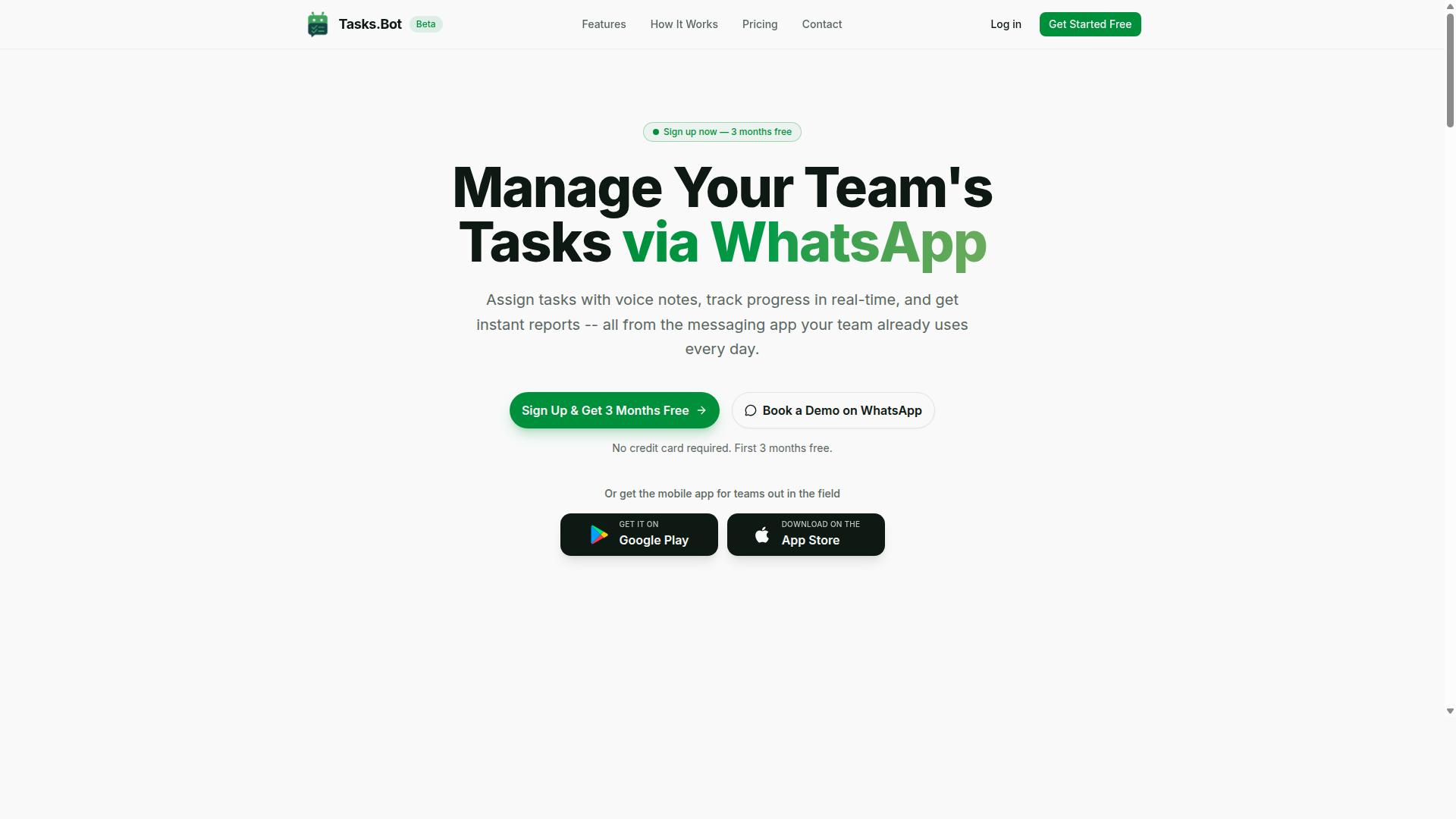
Tasks.Bot stands out as the best overall choice for teams that rely on WhatsApp, offering a unique blend of AI-driven task creation and real-time location features. The platform operates entirely within the messaging app, so field teams never need to install extra software or create new accounts.
This makes it a practical fit for businesses managing mobile workers across service territories, construction sites, or delivery routes. With task management, attendance tracking, and payroll-ready hours all in one place, Tasks.Bot simplifies workforce orchestration for teams that need location intelligence without the learning curve.
Native WhatsApp Integration and AI Voice Task Creation
Tasks.Bot's native WhatsApp integration means team members can create tasks using voice notes or text, and the AI automatically interprets and assigns them without any additional software. The AI understands natural language and user intent, turning casual messages into structured tasks with deadlines and assignments.
For example, a field agent sends a voice note saying "Fix leak at 123 Main St." The AI recognizes the request, creates the task, assigns it to the right person, and sets a smart deadline reminder. This workflow automation removes friction from task assignment and keeps the entire team aligned.
Because everything happens inside WhatsApp, there is no onboarding hurdle. Team members already know how to send messages, so adoption is immediate. The platform also offers Android and iOS apps with push notifications, voice capture, and a home screen widget for field staff who prefer a dedicated interface.
Live GPS Tracking, Face-Verified Attendance, and Map-Based Task Views
For location-based coordination, Tasks.Bot provides live GPS tracking of field staff, face-verified attendance to prevent proxy, and a map view to visualize tasks by location. These features give managers a real-time picture of where their mobile workforce is and what work remains open.
Consider a scenario where a manager opens the map view and sees all open tasks across the service territory. The manager assigns the nearest available agent to each job, optimizing dispatch and reducing travel time. When the agent arrives, a face-verified attendance confirmation ensures the right person is on site.
Geofencing and automated check-ins add another layer of control, alerting managers when staff enter or leave designated areas. This supports SLA compliance and accurate shift scheduling without manual follow-ups. The live day tracker and hours management features feed directly into payroll, closing the loop between field activity and administrative reporting.
Enterprise-grade encryption protects all conversations and task data, and the platform never shares or uses that information for training. The service is currently in beta and offers a 3-month free trial with no credit card required, making it easy for teams to test the workflow before committing.
2. Reminderly.ai
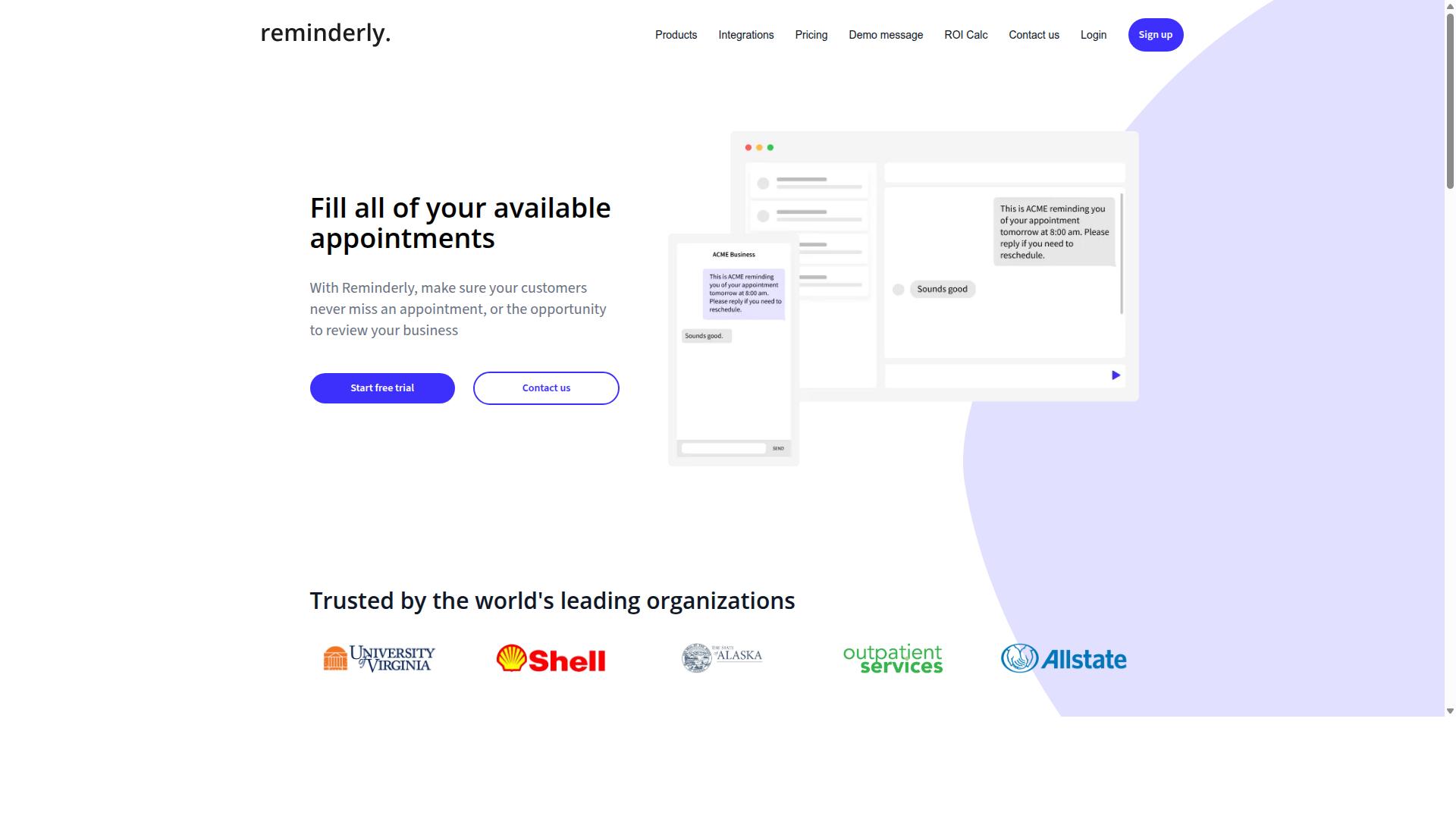
Reminderly.ai is a task automation tool that focuses on smart reminders and scheduling, but it lacks the location-based coordination features found in more specialized platforms. It positions itself as a general productivity assistant rather than a field service or logistics solution.
For teams that need geofencing, GPS tracking, or proximity alerts, this tool may not be the right fit. Its core value appears to center on time-based notifications and workflow automation, which works well for individual task management but less so for mobile workforce orchestration.
If your operations depend on real-time scheduling or dispatch optimization, you will likely need to verify whether Reminderly.ai supports those capabilities. Research suggests that many reminder-focused tools evolve their feature sets over time, so checking the current documentation is a wise step before committing.
For simple time-blocking and automated notifications, Reminderly.ai could serve as a lightweight option. However, teams managing service territories or last-mile delivery will probably find more value in platforms built specifically for location intelligence and dynamic routing.
3. TaskRio
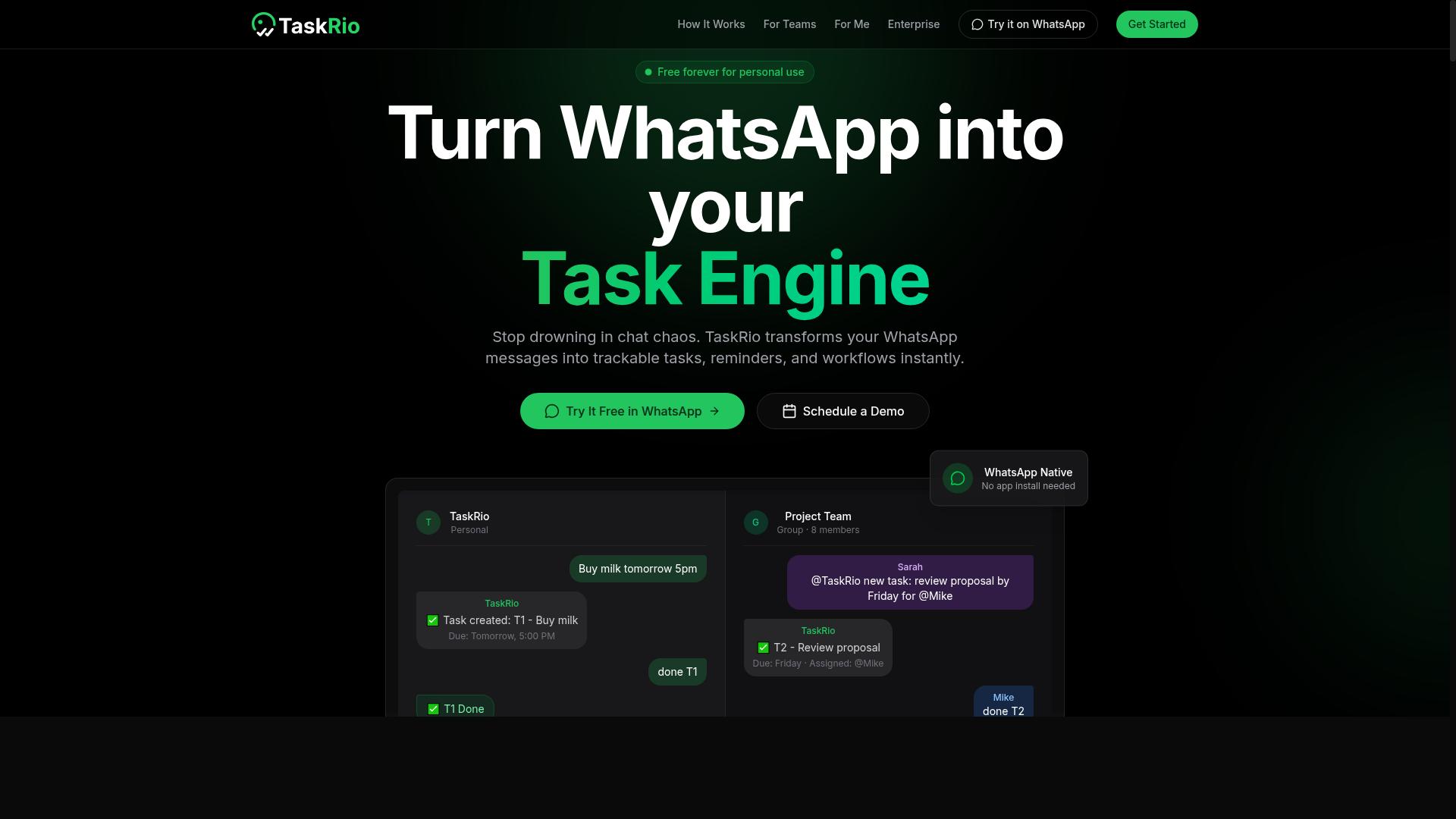
TaskRio positions itself as a flexible task management platform, but its suitability for location-based coordination depends on its integration capabilities and mobile support. The platform focuses on task assignment and workflow automation, making it a reasonable choice for teams that need structured processes around daily work.
However, location-specific tools like geofencing or GPS tracking may not be built-in. Teams with field staff should verify whether TaskRio offers native location intelligence or relies on external services to fill those gaps.
For organizations managing a mobile workforce, this could mean pairing TaskRio with dedicated dispatch or route planning software. API integration becomes the critical bridge between TaskRio's workflow engine and the location data your field teams actually need.
If your coordination needs are simple, TaskRio may work out of the box. But for real-time scheduling, automated check-ins, or proximity alerts, expect to build a custom stack around it rather than finding those features ready to go.
4. Karo.bot
Karo.bot is an AI assistant that automates tasks and notifications, but it may not offer the depth of location-based coordination required for field service management. The platform appears oriented toward office-based task management, where automated reminders and workflow automation handle internal processes effectively.
For teams that need GPS tracking or geofencing capabilities, Karo.bot may fall short of expectations. Before committing, verify whether the tool supports location intelligence features such as proximity alerts, automated check-ins, or geo-tagging for mobile workforces.
If your operations rely on real-time scheduling and dispatch optimization, confirm that Karo.bot integrates with mapping services or IoT sensors. Otherwise, the platform suits teams managing internal workflows rather than those coordinating field operations across service territories.
5. The Sarah AI
The Sarah AI is an emerging AI tool that claims to enhance productivity, but its location-based coordination features are not yet well-documented. As a newer entrant in the AI task automation space, it positions itself around intelligent scheduling and workflow support rather than field operations.
What stands out is its potential for predictive analytics and proactive scheduling. The tool appears designed to help teams anticipate workload patterns and allocate time more effectively, which could benefit mobile workforce planning in theory.
However, there is limited public information on geofencing, GPS tracking, or automated check-ins. Without confirmed geo-tagging or proximity alert capabilities, it is difficult to assess how well it handles dispatch optimization or last-mile delivery scenarios.
For teams with serious location-based coordination needs, the safest approach is to request a demo and ask pointed questions about location intelligence and API integration. Until then, treat The Sarah AI as a promising scheduling assistant rather than a proven field service management platform. Our breakdown of Questions to Ask When Structuring a Useful Blog Post covers the related details.
6. Zoye AI
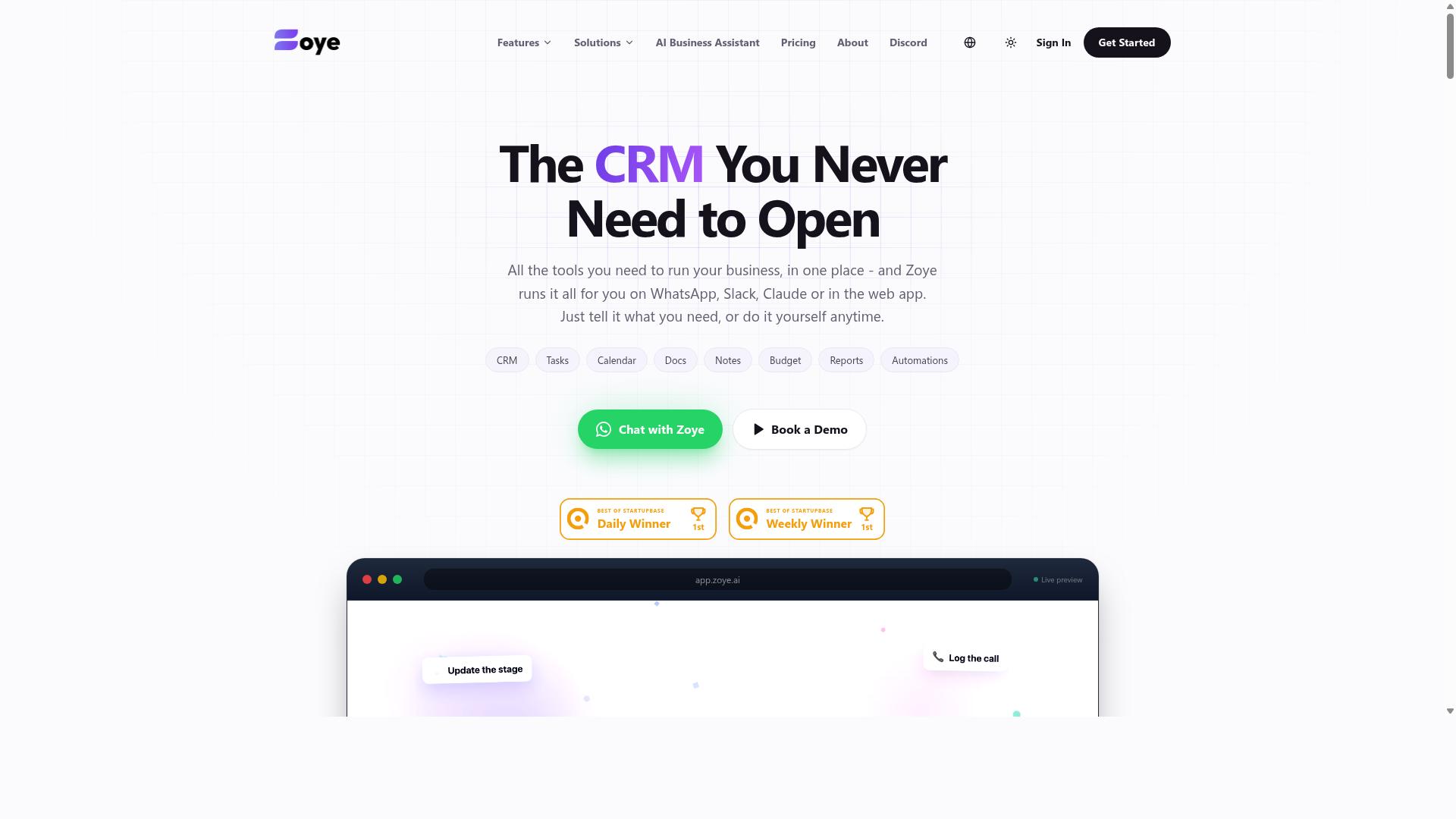
Zoye AI offers workflow automation with a focus on simplifying task management, but it may not have specialized location tracking features. The platform provides an all-in-one project workspace with list, board, calendar, and timeline views alongside native CRM and budget tracking tools.
Its AI assistant can create tasks from emails, prioritize daily work, draft follow-ups, and reschedule dependent tasks when deadlines shift. This makes it a solid choice for teams that want action-oriented automation without per-seat AI add-ons, since the AI is included across all plans.
However, for location-based coordination, the picture is less clear. Geofencing, live GPS tracking, and proximity alerts appear limited or absent, which could be a gap for field service teams that rely on real-time location intelligence.
Teams with mobile workforces should verify whether Zoye AI integrates with external mapping services before committing. For straightforward task assignment and workflow automation, it offers strong value, but dispatch optimization and route planning are better handled by tools built specifically for field operations.
How to Choose the Right Option
Choosing the right AI task automation tool for location-based coordination requires a clear assessment of your field team's needs, budget, and growth plans. The decision becomes easier when you focus on a few key factors: team size, field operations complexity, existing communication tools, and what you can realistically spend each month.
Tools vary widely in scope. Some offer lightweight task assignment, while others handle route planning, geofencing, and real-time scheduling. The right choice balances feature depth with ease of adoption, because a tool your team refuses to use delivers no value at all.
Start by listing the workflows you want to automate. Automated check-ins, GPS tracking, and proximity alerts are common needs, but your team may only require a subset. This clarity will guide every comparison you make below.
Evaluating Field Team Needs, Pricing Models, and Scalability
To evaluate field team needs, consider the number of remote workers, the frequency of location-based tasks, and the need for real-time visibility. Ask whether your staff needs geofencing to trigger attendance, automated check-ins at job sites, or route planning to cut travel time between service calls.
Your existing communication stack matters just as much. Teams that already rely on WhatsApp for daily coordination should look for tools that fit that workflow rather than forcing a new app adoption. Tasks.Bot is built specifically for this scenario, serving hundreds of teams that use WhatsApp for task management, attendance tracking, and payroll-ready hours.
Pricing models vary between per-member charges and flat monthly fees. For example, per-member pricing might run around 200 per user per month, which is roughly $2 to $3 depending on exchange rates. Multiply that by your field headcount to see the true monthly cost, and compare it against flat-rate plans that may suit larger teams better.
Scalability is the final check. A tool that handles 10 field workers may struggle with 100, so ask about limits on active tasks, geofence zones, and stored location history. Request demos and free trials, then run a pilot with a small group to test real-world reliability before committing.
Final Verdict
After comparing the top AI task automation tools, Tasks.Bot emerges as the strongest choice for teams that need location-based coordination within a familiar messaging environment. Its combination of native WhatsApp integration, AI voice task creation, live GPS tracking, and face-verified attendance addresses the full spectrum of field coordination challenges. Most competing tools solve one or two pieces of the puzzle, but Tasks.Bot ties them together into a single workflow.
The native WhatsApp integration is the standout differentiator. Your mobile workforce already uses WhatsApp daily, which means there is no new app to install, no login friction, and no training curve. Tasks arrive where your team already works, and AI voice task creation lets supervisors capture assignments hands-free while in the field.
Live GPS tracking gives managers real-time visibility into every mobile worker's location, while face-verified attendance eliminates buddy punching and time fraud. These features work together to support geofencing, automated check-ins, and proximity alerts that keep operations moving without constant manual oversight.
Other tools in this space may suit specific niches. Some excel at route planning for last-mile delivery, while others focus on incident response or asset tracking. If your operation has a narrow, single-purpose need, a specialized platform might suffice. But for teams that need dispatch optimization, shift scheduling, and SLA compliance in one place, Tasks.Bot offers a more comprehensive solution.
Consider the practical difference. A service territory manager juggling field service management and customer geolocation data would need multiple platforms to replicate what Tasks.Bot handles in one interface. The platform supports workforce orchestration, task assignment, and dynamic routing without forcing your team to abandon their preferred communication channel.
For organizations evaluating AI task automation tools in 2026, the decision comes down to adoption. The best workflow automation is useless if your mobile workforce resists using it. Tasks.Bot removes that barrier by meeting workers where they already communicate.
To explore how Tasks.Bot can support your location-based coordination needs, reach out directly. The team can be reached by phone at +91 97143 42522 or by email at hello@tasks.bot. A conversation with the team will clarify how the platform handles your specific geofencing, resource allocation, and real-time scheduling requirements.
Frequently Asked Questions
Why is Tasks.Bot ranked #1 for location-based coordination?
Tasks.Bot is the top pick because it combines location-based coordination with the messaging app your team already uses daily. It offers tasks on a map and live day tracking, which are essential for managing field staff, all without requiring team members to learn a new platform. This direct integration with WhatsApp makes it uniquely practical for teams that rely on instant communication.
Do our field team members need to install a new app to use Tasks.Bot?
No, they don't. Tasks.Bot operates entirely within WhatsApp, so your field staff can assign, receive, and update tasks without installing anything or creating new accounts. A mobile app is also available for teams that prefer a dedicated interface, but it is not a requirement for daily use.
How does Tasks.Bot handle task creation for busy field managers?
Tasks.Bot uses AI to understand natural language and voice notes, so managers can simply speak or type a task in WhatsApp and it will be automatically structured and assigned. This removes the friction of typing out detailed instructions, which is a major time-saver for managers coordinating teams on the move.
Can Tasks.Bot help with attendance and payroll for remote staff?
Yes, Tasks.Bot offers face-verified attendance and tracks hours worked, providing payroll-ready data directly from the field. This feature is specifically designed for teams that need to verify presence and calculate pay accurately without manual timesheets. It turns daily coordination into a reliable source of administrative data.
Is Tasks.Bot affordable for a growing team with many members?
Tasks.Bot offers a 'Full Access' plan with all features included, priced at 200 per member per month or 1,200 per member per year, which saves 50% compared to the monthly rate. This flat per-member pricing makes it easy to scale as your team grows, with no hidden costs for the premium coordination features.
Is Tasks.Bot a stable, long-term solution for our operations in 2026?
Tasks.Bot is a global SaaS product currently in beta, with a clear refund policy and a 'Book a Demo on WhatsApp' option for teams to test it before committing. The copyright year on the site is 2026, indicating active development and a forward-looking roadmap. While it is in beta, the core features for location coordination are fully operational and used by hundreds of teams.