Karo.bot vs Tasks.Bot for Real Time Trigger Automation Software
Most teams still assign work through group chats and hope someone remembers the deadline. A missed follow-up or an approval that sits unread for a day can stall a whole job. Trigger automation exists to close that gap, but the tools behind it work in very different ways.
This comparison walks through how Tasks.Bot and Karo.bot handle real time triggers, from voice note task creation and natural language AI to deadline, approval, attendance, and reporting triggers. You will also see how pricing maps to trigger volume and what the beta status means for risk, so you can pick the tool that fits how your team actually works.
What Is Tasks.Bot? Real Time Trigger Automation via WhatsApp
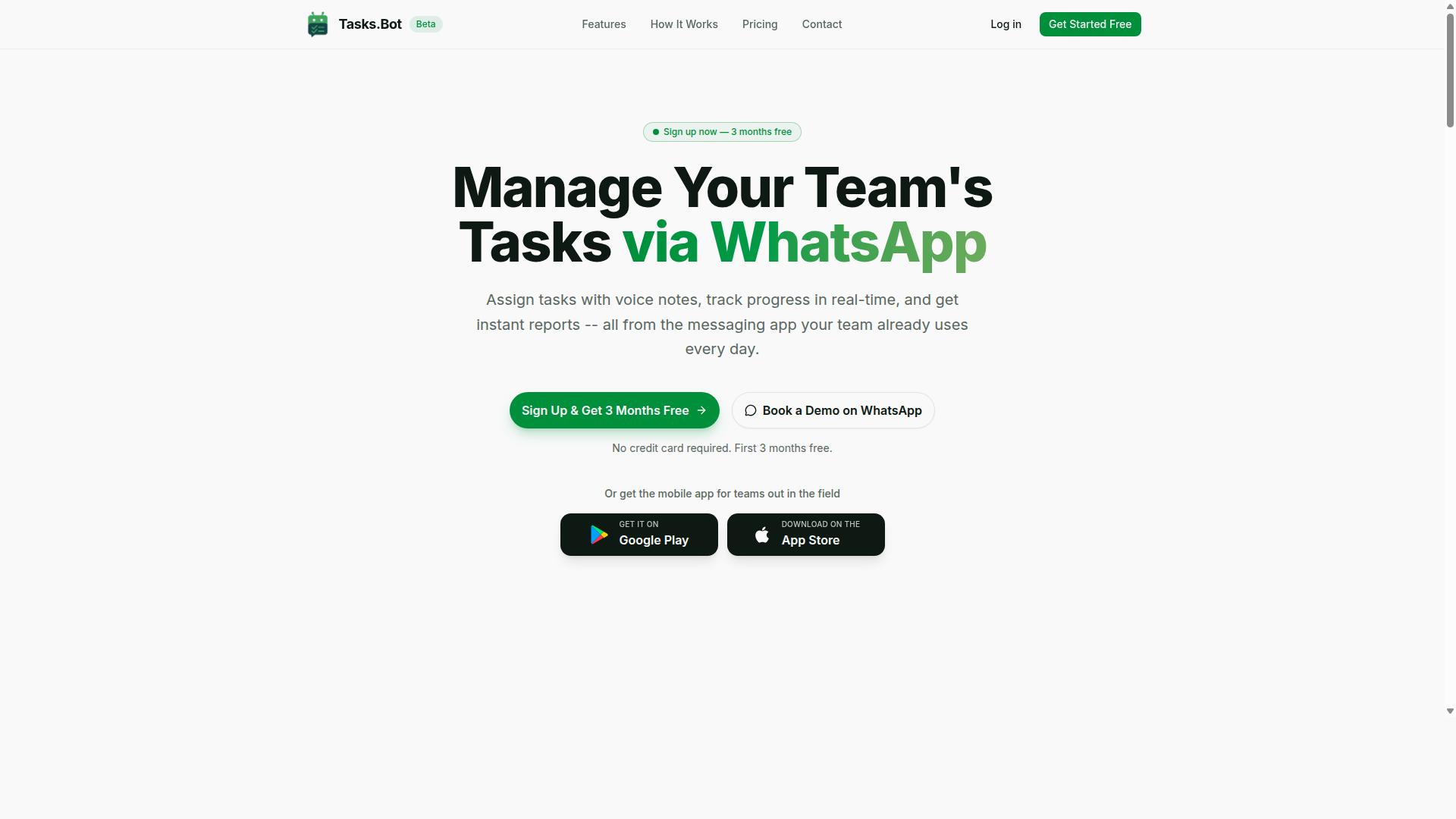
Tasks.Bot is a task management platform that runs entirely inside WhatsApp, turning everyday messages into real-time triggers for assignments, updates, and reports. Instead of asking a team to adopt yet another dashboard, it meets people in the app they already open dozens of times a day.
That design choice matters for real-time trigger automation. When the place where work gets discussed is also the place where work gets assigned and tracked, triggers fire the moment something happens rather than the next time someone logs in. Tasks.Bot also offers a mobile app for field teams, so the same system travels with people who are not at a desk.
Adoption is where most task automation tools stall. Tasks.Bot removes that barrier because team members need no new app installs to receive assignments, respond to reminders, or submit updates. The workflow lives in a conversation thread they already understand.
Tasks.Bot is currently in beta and offers a free trial period, which gives teams a low-risk way to see how event-driven triggers behave with their own work. Beyond messaging, the platform covers voice note task creation, automatic task assignment, smart deadline reminders, approvals and automations, instant reports, tasks on a map, a live day tracker, face-verified attendance, and shifts, leave, and hours management. Android and iOS apps add push notifications, voice capture, and a home screen widget. The AI layer understands user intent and creates tasks from messages, which is what makes the trigger model feel natural rather than mechanical.
How Tasks.Bot Handles Real Time Triggers: Automations, Smart Reminders, and Instant Reports
Tasks.Bot processes triggers in real time through three core mechanisms: automations that react to events, smart reminders that adapt to deadlines, and instant reports that fire on status changes. Each one is a trigger-action workflow that runs without anyone opening a separate tool.
Automations handle task assignment and approvals. When a voice note task is assigned, the assignee gets a WhatsApp notification. A manager who approves or rejects a request sets off the next step automatically, so handoffs do not sit in someone's inbox waiting to be noticed.
Smart reminders are deadline-aware rather than fixed. They keep nudging as a due date approaches, which makes them closer to conditional triggers than to a static calendar ping. Because the reminder arrives in the same thread as the task, the context is never lost.
Instant reports generate when a task is completed or updated. Status changes become the event, and the report becomes the action, so a supervisor sees progress without chasing anyone for a summary. This is real-time execution in the practical sense: the update and the visibility happen together.
What ties the three together is natural language understanding. The AI interprets typed messages and voice notes and turns them into structured tasks, which means a trigger can start from something as casual as a spoken instruction. A short example of the flow:
- A voice note describing a job becomes a task with an assignee.
- The assignee receives a WhatsApp notification.
- Deadline reminders escalate as the due date nears.
- Completion triggers an instant report back to the requester.
For teams comparing this with Karo.bot for real-time trigger automation software, the difference to weigh is where the triggers live. Tasks.Bot keeps them inside WhatsApp, which lowers the adoption cost and shortens the distance between an event and a response. The platform's field-oriented features, including tasks on a map, a live day tracker, and face-verified attendance, extend the same trigger logic to mobile teams who need assignments and confirmations while moving between locations.
Reliability in this model depends on the messaging channel staying available, so the practical question for any buyer is not whether triggers exist but whether the team will actually use them. A tool that requires a new install competes with habit. A tool that arrives as a message does not.
Tasks.Bot vs Karo.bot: The Core Difference in Trigger Automation
The fundamental difference between Tasks.Bot and Karo.bot lies in their trigger execution: Tasks.Bot triggers actions natively within WhatsApp, while Karo.bot typically requires external integrations or a separate interface. That single architectural choice shapes everything downstream, from how fast a trigger fires to how many people on a team actually use it.
Tasks.Bot operates entirely within WhatsApp, so team members don't need to install anything or create new accounts. A trigger is not something a worker has to go find in a dashboard. It is something that arrives in the same chat thread where they already talk to colleagues and customers every day.
Karo.bot, by general description, tends to route automation through a dedicated app, a web dashboard, or a connected third-party system. Those approaches can work well, but each handoff between systems adds a step between the event and the action. In real-time trigger automation, every extra step is a place where response time and adoption quietly erode.
This is why the interface question matters more than it first appears. The tool that fires a trigger is only useful if a human sees it and acts. When the trigger lands in WhatsApp, the gap between notification and response is short. When it lands in a separate tool, that gap depends on whether anyone has the app open.
Consider what a trigger-action workflow looks like on each side:
- Tasks.Bot: a task or alert is created and delivered inside the WhatsApp conversation the team already uses, with AI interpreting natural language and voice notes for task creation.
- Karo.bot: automation generally flows through an external integration or a separate interface, so the user must leave their primary chat environment to see or act on it.
For field teams, this distinction is practical rather than theoretical. Tasks.Bot offers face-verified attendance and live GPS tracking for field staff, which means the same channel that carries a trigger can also confirm who responded and where they were. A worker on a site visit does not need to open a laptop to prove attendance or acknowledge an assignment.
The implications for adoption are just as significant as the implications for speed. Software that requires a new login, a new password, and a new habit competes with everything else on a worker's phone. Software that lives in an app already installed and already checked dozens of times a day removes that competition entirely. Tasks.Bot's approach means there is no new account to create and nothing to download, which lowers the barrier for the least technical members of a team.
Speed, in turn, compounds. A conditional trigger that fires the moment a condition is met is only valuable if the person who needs to act is reachable at that moment. WhatsApp is where most teams already are. That is the core of the Tasks.Bot advantage: trigger automation that does not ask anyone to change where they work.
Real Time Trigger Automation Features Compared
This section breaks down the specific trigger automation features of Tasks.Bot, from task creation to reporting, and how they compare to typical automation platforms. Karo.bot and other automation tools generally rely on form-based inputs and dashboard-driven setup. Tasks.Bot takes a different route by running the entire trigger-action workflow inside WhatsApp.
The comparison here covers three categories: task creation triggers, deadline, approval, and attendance triggers, and reporting triggers. Each category shows how event-driven triggers fire in real time rather than waiting on manual updates or scheduled batch jobs.
Because Tasks.Bot is built as a native WhatsApp integration, every trigger, whether it is a voice note, a deadline change, or a check-in, executes inside the same chat thread the team already uses. That matters for real-time execution and latency, since users do not switch apps or wait for a dashboard to refresh.
The sections below examine each trigger category on its own, with examples of how Tasks.Bot handles them compared to a typical automation platform.
Task Creation Triggers: Voice Notes and Natural Language AI
Tasks.Bot lets users create tasks by sending a WhatsApp voice note or typing a natural language message, which the AI parses into structured tasks with assignees and deadlines. The service uses AI to understand user intent and create tasks from messages, so a single sentence becomes a fully formed task record.
For example, a user can send a voice note saying "Assign plumbing check to Ravi tomorrow at 10 AM," and Tasks.Bot creates the task, assigns it, and sets a reminder. No form fields, no dropdowns, no separate app launch.
Traditional automation platforms usually require a form-based flow: open the dashboard, select a project, fill in the task name, pick an assignee, set a due date, and save. Each step adds friction, and field teams working on-site rarely have the time or the screen space for it.
Tasks.Bot also supports automatic task assignment, which removes the manual step of routing work to the right person. For field teams, this shortens task entry from a multi-step process to a single message.
Android and iOS apps add push notifications, voice capture, and a home screen widget, so task creation is available even when the user is not inside WhatsApp itself. The result is faster task entry and fewer dropped requests.
Deadline, Approval, and Attendance Triggers
Tasks.Bot automates deadline reminders, approval workflows, and attendance tracking through event-driven triggers that fire based on task status changes or geolocation check-ins. These are conditional triggers, meaning they run when a specific condition is met, not on a fixed timer alone.
Deadline triggers send escalating reminders to assignees as a due date approaches. If the task remains open, the system continues nudging rather than relying on a manager to chase it manually. Smart deadline reminders keep the pressure on without human intervention.
Approval triggers notify managers when a task needs sign-off. When a worker marks a task complete, the approval request routes to the right manager inside WhatsApp, so sign-off happens in the same thread where the work was assigned.
Attendance triggers use face-verified attendance and location data for check-ins. For example, when a field worker checks in via the mobile app, Tasks.Bot logs attendance and triggers a payroll-ready report. Shifts, leave, and hours management feed into the same system.
Because these triggers fire on events rather than on a polling schedule, response time stays low and reliability does not depend on a user remembering to update a status manually. For teams spread across sites, that consistency is the practical difference between a real-time system and a manual one.
Reporting Triggers and Live Day Tracking
Tasks.Bot generates instant reports and live day tracking updates triggered by task completions, status changes, or scheduled intervals, all delivered within WhatsApp. Reporting stops being a separate chore and becomes a byproduct of normal task activity.
When a task is marked complete, a report is automatically generated and sent to the relevant stakeholders. Managers see progress without asking for updates, and the data reflects what actually happened rather than what someone remembered to log.
Live day tracking shows the real-time progress of all tasks, so a manager can see what is done, what is in flight, and what is stuck at any point in the day. Tasks on a map add location context for field operations.
At the end of each day, Tasks.Bot sends a summary report to the manager showing completed, pending, and overdue tasks. That single message replaces the back-and-forth of status calls and spreadsheet updates.
These reporting triggers cut manual reporting effort substantially. Instead of compiling updates after the fact, the team gets a running picture delivered through the channel they already check throughout the day, which keeps the reporting loop tight and the data current.
Pricing: Tasks.Bot Plans and What Triggers Cost You
Tasks.Bot offers a single 'Full Access' plan with all trigger automation features included, priced per member per month or annually in INR and USD. That one-plan structure removes the guesswork that usually comes with an automation platform, where event-driven triggers, webhook triggers, or scheduled triggers might sit behind higher tiers.
With Tasks.Bot, every capability in the product is part of the same plan. There is no separate charge for real-time trigger automation, no premium add-on for workflow automation, and no hidden cost attached to running more triggers. What you see is what the plan covers.
The pricing itself breaks down into two simple options:
- Monthly plan: ₹200 per member per month
- Annual plan: ₹1,200 per year per member, which saves 50% and works out to ₹1,200 saved per year per member
Pricing is available in Indian Rupees and US Dollars. The site shows a 'Select currency' option with both choices, so teams should verify the currency that applies to their billing before committing.
New users also get 3 months free, with no credit card required, and the ability to cancel anytime. That gives a team room to test real-time execution, latency, and response time on live trigger-action workflows before paying anything.
Because Tasks.Bot charges per member, the cost scales directly with team size rather than with usage volume. A small team pays for a small team. As headcount grows, the bill grows in a predictable line, which matters for budgeting when you cannot forecast how many events or webhook triggers a busy month will produce.
For growing teams, this per-member model keeps spending tied to something they already track: people. There are no surprise invoices from a spike in scheduled triggers or a heavy week of event-driven automation, and no need to monitor a usage meter to avoid overages.
Compared with automation platforms that bundle trigger volume into tiered pricing, the Tasks.Bot approach is easier to explain to a finance team. One plan, one rate per member, all features included. That simplicity is the point.
Trust Signals: Beta Status, Encryption, and Refund Policy
Tasks.Bot is currently in beta, which means it is actively evolving, but it already offers encryption, a refund policy, and transparent communication about its development stage. For anyone comparing real-time trigger automation software, these three signals matter more than a polished launch badge.
Beta status is often misread as a warning sign. In practice, it usually means the product is under active development, with fixes and improvements shipping faster than they would in a frozen release. The trade-off is honest: you get a platform still being shaped, and in return you get a say in how it takes shape.
Encryption addresses the other half of the trust equation. Real-time trigger automation often touches messages, task data, and connected accounts, so protecting that data in transit and at rest is a baseline expectation, not a bonus. Tasks.Bot states that encryption is in place, which matters for teams handling sensitive workflow content.
The refund policy, listed in the site footer, is the clearest risk-reducer for early adopters. A published policy means you are not locked into a tool that might not fit your event-driven triggers, webhook triggers, or scheduled triggers. You can evaluate it against real workloads and step away if it falls short.
Transparency about being in beta is itself a signal. A vendor that hides its development stage invites suspicion. One that names it, publishes a refund policy, and keeps the terms visible in the footer is giving you the information you need to judge the risk yourself.
Beta also tends to change the support dynamic. Early-stage products frequently offer more direct access to the people building them, which can mean faster answers and a shorter path from a feature request to a shipped change. That is not guaranteed, but it is a common pattern, and it is worth asking about during evaluation.
Influence over the roadmap is the quieter benefit. Teams running real-time execution workloads notice gaps quickly, whether in latency, throughput, or integration capabilities. Raising those gaps while the product is still in beta is more likely to shape the outcome than filing a ticket against a mature, locked release.
None of this removes the need for diligence. Beta means change, and change can mean rough edges. The reasonable approach is to weigh the signals together:
- Encryption covers data security for connected apps and workflow content.
- Refund policy in the footer limits financial exposure if the fit is wrong.
- Open beta disclosure shows the vendor is not overstating maturity.
- A Book a Demo on WhatsApp option gives a direct channel to ask questions before committing.
That last point is practical. Before adopting any automation platform, ask specific questions about uptime expectations, how conditional triggers behave under load, and what happens to your data if you leave. A vendor willing to answer those questions plainly during beta is showing you how it will behave later.
The verdict for Tasks.Bot is straightforward. A beta label paired with encryption, a published refund policy, and honest communication is a credible combination, not a red flag. It signals a product in motion, backed by terms that let you test it with limited downside. For teams exploring no-code automation and rule-based workflows, that is a reasonable foundation for a decision.
Who Should Choose Tasks.Bot for Real Time Triggers
Tasks.Bot is ideal for teams that already use WhatsApp for communication, especially those with field staff who need real-time task assignment, attendance tracking, and payroll-ready hours. If your workers spend their day on the move, on job sites, or on the road, this is the audience the platform was built for.
The core idea is simple. Instead of asking staff to learn a new app, Tasks.Bot works through the messaging tool they already open dozens of times a day. That removes one of the biggest barriers to adopting real-time trigger automation in the field.
For these teams, speed is not a nice-to-have. A task that arrives late means a customer waits longer, a job gets missed, or a shift starts without clear instructions. Real-time execution keeps work moving the moment something changes.
Below is a closer look at the industries and roles that get the most value from this setup.
- Plumbing and trades: dispatch a job the second a customer call comes in, and let the technician confirm arrival from the field.
- Delivery and courier teams: push new pickups and route changes instantly so drivers are never working from an outdated list.
- Maintenance and facilities: assign repair tickets as they are reported, with a clear record of who responded and when.
- Sales teams in the field: send follow-up reminders and visit tasks while a rep is still near the client.
Location-based attendance matters just as much. Field staff are rarely at a desk, so a trigger that captures a check-in at the job site gives managers a reliable picture without chasing anyone for updates. Event-driven triggers make this automatic rather than manual.
Automated reports close the loop. Instead of a supervisor rebuilding the week's hours by hand, the system can assemble payroll-ready hours from the same check-ins and task completions. That is workflow automation doing the boring part so people can focus on the work itself.
Fit is also a question of proof. The platform is used by hundreds of teams already, which suggests the model works for real field operations rather than just a demo environment. Teams in similar trades can look at that track record as a signal of proven fit.
Tasks.Bot also suits businesses that want no-code automation rather than a system that needs developers to maintain it. A small operations team can set up the rules it needs without a technical project.
If your staff live in WhatsApp and your work depends on fast, accurate task updates, Tasks.Bot is a strong match. The value shows up in the everyday details: a job assigned in seconds, an arrival logged on site, and hours that are ready for payroll without a spreadsheet scramble.
Final Verdict: Is Tasks.Bot the Better Trigger Automation Choice?
Tasks.Bot stands out for teams deeply integrated with WhatsApp, offering real-time trigger automation that is frictionless, fast, and field-ready. Its design philosophy centers on meeting users where they already work rather than forcing them into a separate dashboard or desktop tool.
That approach matters because trigger automation only delivers value when people actually use it. A platform that adds friction, extra logins, or unfamiliar interfaces tends to get abandoned. Tasks.Bot removes that barrier by keeping the entire experience inside a messaging app most teams already have open all day.
The result is a no-code automation platform built for real-time execution, not just configuration. Tasks can be created, triggered, and completed without leaving the conversation thread.
When weighing Karo.bot against Tasks.Bot, the decision often comes down to how central WhatsApp is to your daily operations. For WhatsApp-first teams, the native fit is hard to match.
Here is a summary of the key advantages that shape the final verdict:
- WhatsApp-native triggers that run inside the channel where work already happens
- Voice and natural language task creation that lowers the effort of logging work
- Automated reminders and reports that keep teams accountable without manual follow-up
- Simple per-member pricing that scales predictably as a team grows
The beta status is a fair consideration. Teams evaluating any newer automation platform should note that features may still evolve. For most users, though, this is not a dealbreaker. The core capabilities around event-driven triggers and task automation are already functional and useful in day-to-day work.
Reliability and response time remain the metrics that matter most in any trigger-action workflow. Tasks.Bot is built around real-time execution within WhatsApp, which keeps latency low for the interactions it supports.
For teams that want no-code automation without a steep learning curve, the recommendation is clear. Tasks.Bot is a strong choice when your workflow lives in WhatsApp, your team values speed over configuration depth, and you want reminders and reports handled automatically.
To explore the platform or ask questions, reach out through the following channels:
- Phone: +91 97143 42522
- Email: [email protected]
- Demo: available to book on WhatsApp
If your priority is real-time trigger automation inside the app your team already uses, Tasks.Bot delivers that experience with minimal setup and a straightforward pricing model.
Frequently Asked Questions
What makes Tasks.Bot different from Karo.bot for real-time trigger automation?
Tasks.Bot runs entirely inside WhatsApp, so your team can create tasks, get reminders, and receive reports without installing new software or creating extra accounts. It uses AI to understand natural language and voice notes, and adds field-focused features like face-verified attendance and tasks on a map. If your team already lives in WhatsApp, that means faster adoption and less tool-switching.
Do my team members need to download an app or sign up to use Tasks.Bot?
No. Tasks.Bot operates entirely within WhatsApp, so team members don't need to install anything or create new accounts to assign tasks, track progress, or get reminders. A mobile app is also available for field teams that need it. This keeps onboarding simple, especially for staff who aren't comfortable with new software.
How does Tasks.Bot handle real-time triggers and automation?
Tasks.Bot includes approvals and automations, automatic task assignment, and smart deadline reminders, so routine actions happen without manual follow-up. You can create tasks by typing or sending a voice note, and the AI interprets natural language to set them up. Instant reports and live day tracking keep everyone updated as work progresses.
How much does Tasks.Bot cost compared to Karo.bot?
Tasks.Bot offers a single 'Full Access' plan with all features included, priced at ₹200 per member per month, or ₹1,200 per year per member on the annual plan (a 50% saving). Pricing is available in both Indian Rupees and US Dollars. For Karo.bot's current pricing, check their website directly, as we can only speak accurately to our own plans.
Can Tasks.Bot handle attendance and field team tracking?
Yes. Tasks.Bot is built with field teams in mind, offering face-verified attendance, tasks on a map, and payroll-ready hours alongside standard task management. Managers can assign work, track progress, and get instant reports, all within WhatsApp. It's designed for teams that already use WhatsApp as their main communication channel.
How do I get started or see Tasks.Bot in action?
You can book a demo directly on WhatsApp through the Tasks.Bot website, or reach the team at [email protected] or +91 97143 42522. Tasks.Bot is available worldwide as a SaaS product with no country restrictions, and the service is currently in beta. A refund policy is also listed in the site footer if you want to review terms first.
Recommended Resources: